

As I have previously mentioned, one of my favorite questions is to ask one’s favorite color. Most people say blue. The epistemic value of this line of inquiry is up for debate. But more of us ought to ask what the color blue actually is.
I want to probe at whether the color blue itself (the “blueness” of blue), and all other conscious experiences (of sound, touch, emotion, etc.), are phenomena distinct from the neurophysiological causes of consciousness. I’ll refer to the phenomena of conscious experience as qualia.
This will be the first of two posts in a short series concerning philosophy of mind and philosophy of science.

In my first post, I will attempt to provide a thorough definition of qualia. I am of the opinion that muddled or aged terminology has led to widespread misconceptions on the nature of consciousness generally and qualia specifically.
My post is exploratory (I am not a scientist; I am not a philosopher). I will avoid making many hard claims as to the nature of consciousness. I will, however, try to clarify the subjects at hand, so that we can have a more meaningful conversation about the unknowns of consciousness. On that basis, I will make a case for qualia as a unifying term for conscious phenomena, even under theories that might otherwise seek to deny qualia. Unless we confirm they are truly illusions, qualia designate an important fact of experience, meaning we should retain the term while debating the definition and underlying explanation.
Throughout our discussion, I will advance a case that qualia ought to be an object of scientific, not philosophical investigation. I’ll go into greater detail on this topic in the second post of this series, where I will critique dualist theories of consciousness.
Qwat are we talking about, anyway?
This problem space is often referred to as “the hard problem of consciousness.” I have noticed philosophy of mind is a very popular subject on Substack, meaning I am of the zeitgeist and possibly unoriginal.
The “easy” problem of consciousness examines the biology underpinning consciousness to understand how neurophysiology operates. The hard problem debates how and why consciousness arises from these biological processes. Qualia are a concept for what arises. What is our subjective experience of reality?
Here are a few simplified examples of subjective experience.
I observe a blue sky. What is my experience of the color blue? A quale of blue.
I put my hand to a flame. What is my experience of warmth? A quale of warmth.
I hear a crash. What is my experience of that loud noise? A quale of sound.
I taste a cake. What is my experience of that sweet dessert? A quale of taste.
I feel joy. What is my experience of that joy? A quale of joy.
I stub my toe. What is my experience of that pain? A quale of pain.
etc.
Note that I state these to build intuition around qualia, without making substantive claims as to their correctness. Also note that there is nothing ipso facto incompatible between neurophysiology and subjective experience. Either qualia are real, and we ought to seek how to explain them with science, or qualia are illusions, and we ought not to discuss them. Qualia are not incompatible with a physicalist explanation of neurophysiology.
Philosophy of mind is gifted with several well-known thought experiments, which might serve as a further introduction to the problem space. Take these as intuition pumps, not as proofs of their conclusions.
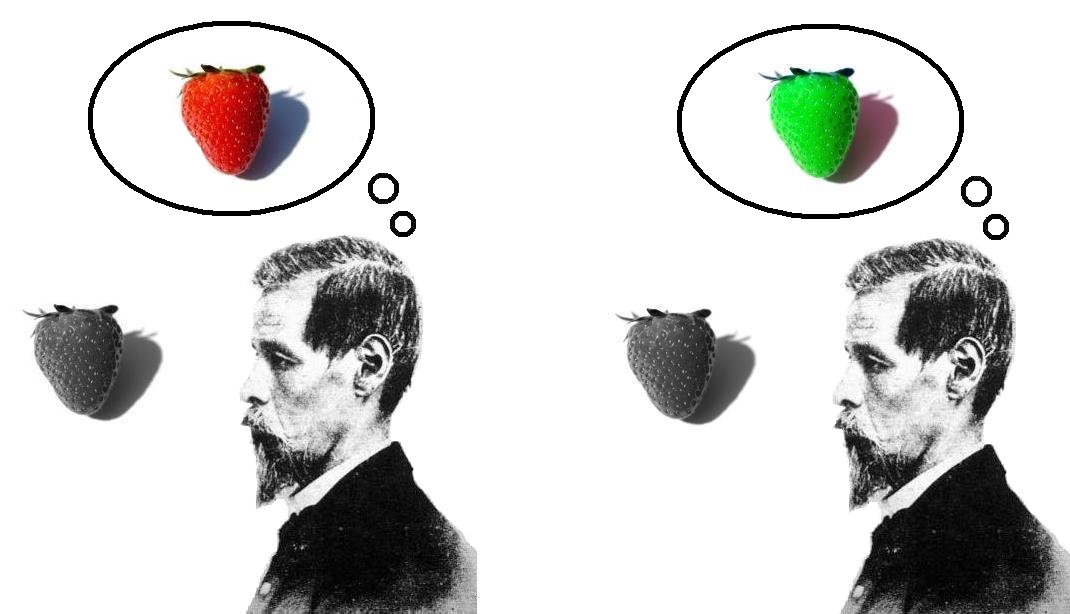
Inverted spectrum: Is it logically possible to imagine an exact physical clone of myself who has an inverted experience of color (experience a phenomenon, or quale, of green, rather than red)? If yes, then our experience of consciousness is logically distinct from the neurophysiological perception of stimuli.
Philosophical zombies. Can we imagine an exact physical clone of ourselves that does not have conscious experience? A version of myself that is entirely mechanical, with no phenomenological experience. If yes, consciousness is logically distinct from the brain.
Mary’s room: Suppose a brilliant color theorist spends her entire life in a black-and-white room. She knows all one can about color within a black-and-white room. When she steps outside, and sees the blue of the sky, does she learn something new? If yes, then there is something about our conscious experience of the world distinct from our physical being.
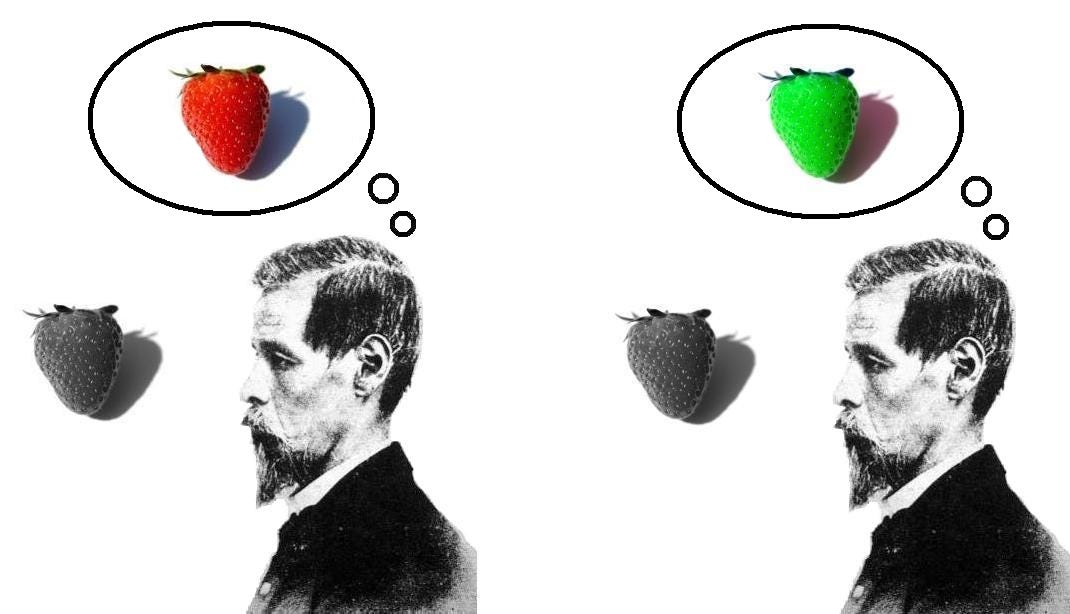
Of these thought experiments, the inverted spectrum is the one I find most cogent. The colors red and green are chosen because it naively seems they may be inverted without breaking any laws of color theory. It does not mean that red and green actually can be inverted, or that our experience of color actually does differ. It merely highlights a fundamental uncertainty as to the equivalence of phenomenal experience, and doubts such a question could be solved by recourse to the known physical world.
Let’s review the Wikipedia definition of qualia.
In philosophy of mind, qualia (singular: quale) are defined as instances of subjective, conscious experience. […] Examples of qualia include the perceived sensation of pain of a headache, the taste of wine, and the redness of an evening sky.
That’s a good start! But it doesn’t drive toward the important qualification of whether a conscious experience is anything special beyond biological reactions. Can we locate qualia somewhere in our neurophysiology? Are qualia a property of neurophysiology, i.e. some unknown aspect of neural activity? Or are qualia distinct entities caused by neural activity, even a distinct substance with an unknown physical substrate? These are all questions about the ontological status of qualia.
Another angle for investigating qualia is to ask about their causality. Here, I might ask whether our minds are closer to electric kettles or steam engines. Is phenomenal consciousness a side-effect of neurophysiology (the steam boiled off by heat), or somehow essential to the propulsion of the human mind (the steam driving the engine)?1 When we say we are “self-aware,” do we mean we are aware of our qualia, or simply that our neurophysiology can introspect into itself, and qualia remain an outcome outside the causal chain of introspection?
Decisions as to the ontological and causal status of qualia are at least partially determinative of the available explanations for phenomenal consciousness. As a thought experiment, I created a matrix across the two dimensions of ontological and causal status of qualia, and then assessed my own credence for each. This is a subjective exercise meant to showcase my own “best guess” on the available evidence. In practice, theories exist along a spectrum, with different tolerances for the possibility of properties vs entities, and different interpretations of physical vs natural vs non-natural states (not included as a dimension here).
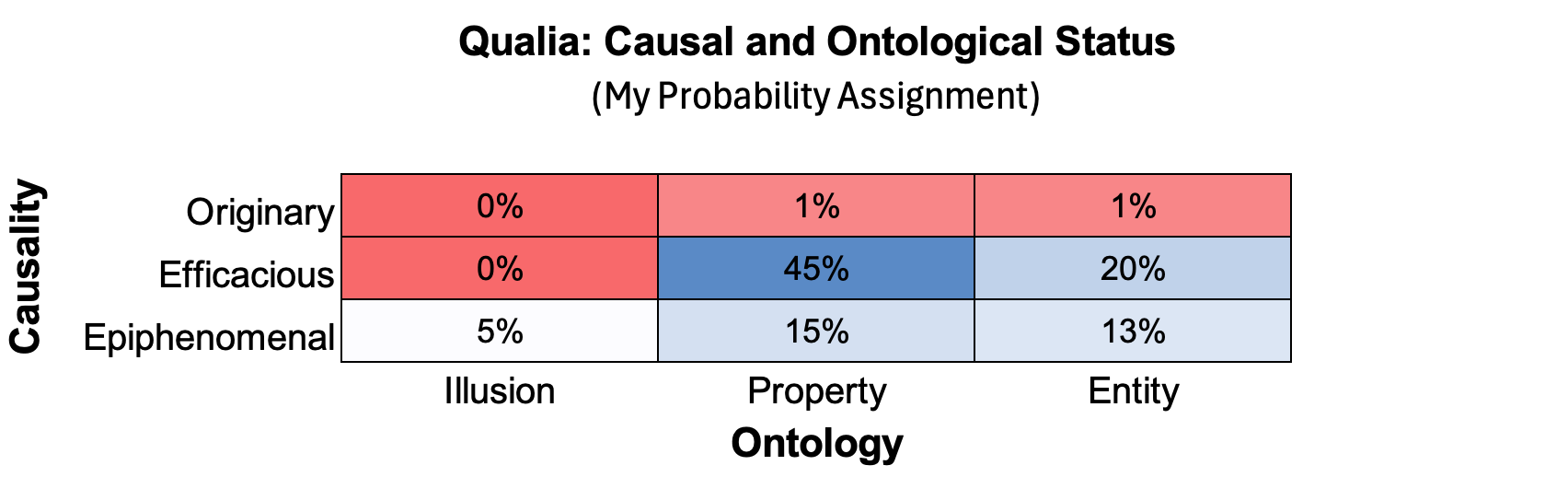
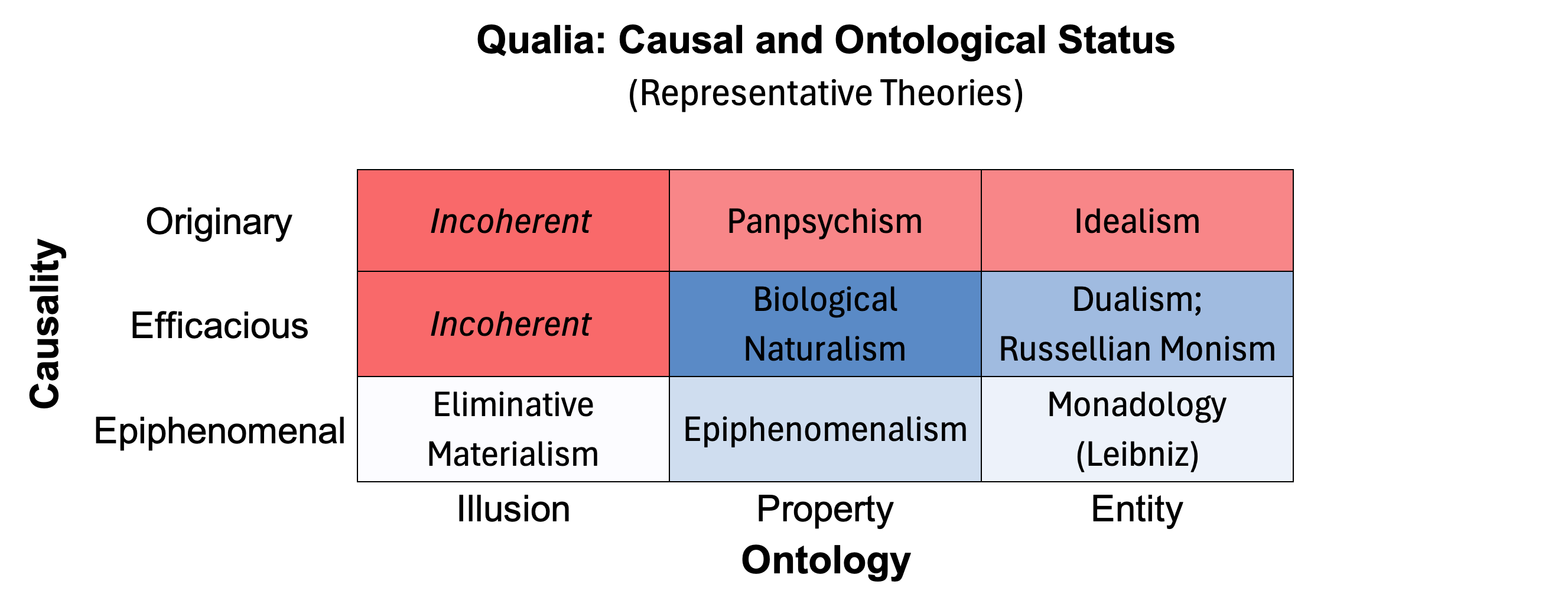
I accept my subjective experience of consciousness as valid, so I am very skeptical of the idea that qualia are an illusion, i.e. do not exist (left column). If qualia are an illusion, they must be epiphenomenal, meaning they have no causal impact on neurophysiology (the unreal cannot affect the real). I’d associate this box with eliminative materialism or illusionism. Some versions of functionalism would also fit here.
I accept neurophysiology as the cause for perception and cognition, so I find it very unlikely that consciousness or qualia are the independent causal origin of cognition and perception (top row). I am unsure how to qualify this row as anything other than panpsychism / idealism / mysticism.
If qualia are a property of neurophysiology (i.e., some as yet unknown aspect of neurophysiology), then I find it much more likely that they are efficacious. Note that I would say qualia are almost certainly not a property of neurophysiology per se, but perhaps a fundamental property of physics or nature (like a new fundamental force). Below, I proposed biological naturalism as the representative theory, but I think you can explode this box to fit several contemporary theories of consciousness. Thomas Nagel probably fits here, as does Searle. I could buy an argument for placing Chalmers here as well.
If qualia are distinct entities, with a distinct natural substrate (pretend there is a “particle of consciousness”), then I would still venture they are efficacious, though with less certainty than if they are properties. Cartesian dualism might be an extreme version of an entity view, which suggests an entirely different substance to consciousness from physical reality. As mentioned, my matrix does not assess a dualist vs physicalist/naturalist claim for such an entity; my 20% assignment is only for the naturalist version of the argument.
As an intuition pump, I’ve made a best effort to plug in a representative philosophical theory into each box. A few of these could be argued in different directions, so take it with a grain of salt. When pressure testing my matrix against Russellian Monism, or Chalmers’ Dualism, it became apparent a lot of weight was placed on how we used the word “property,” e.g. whether we mean a property of a natural entity (like mass or heat) or a property of reality itself (like, well, an entity?).
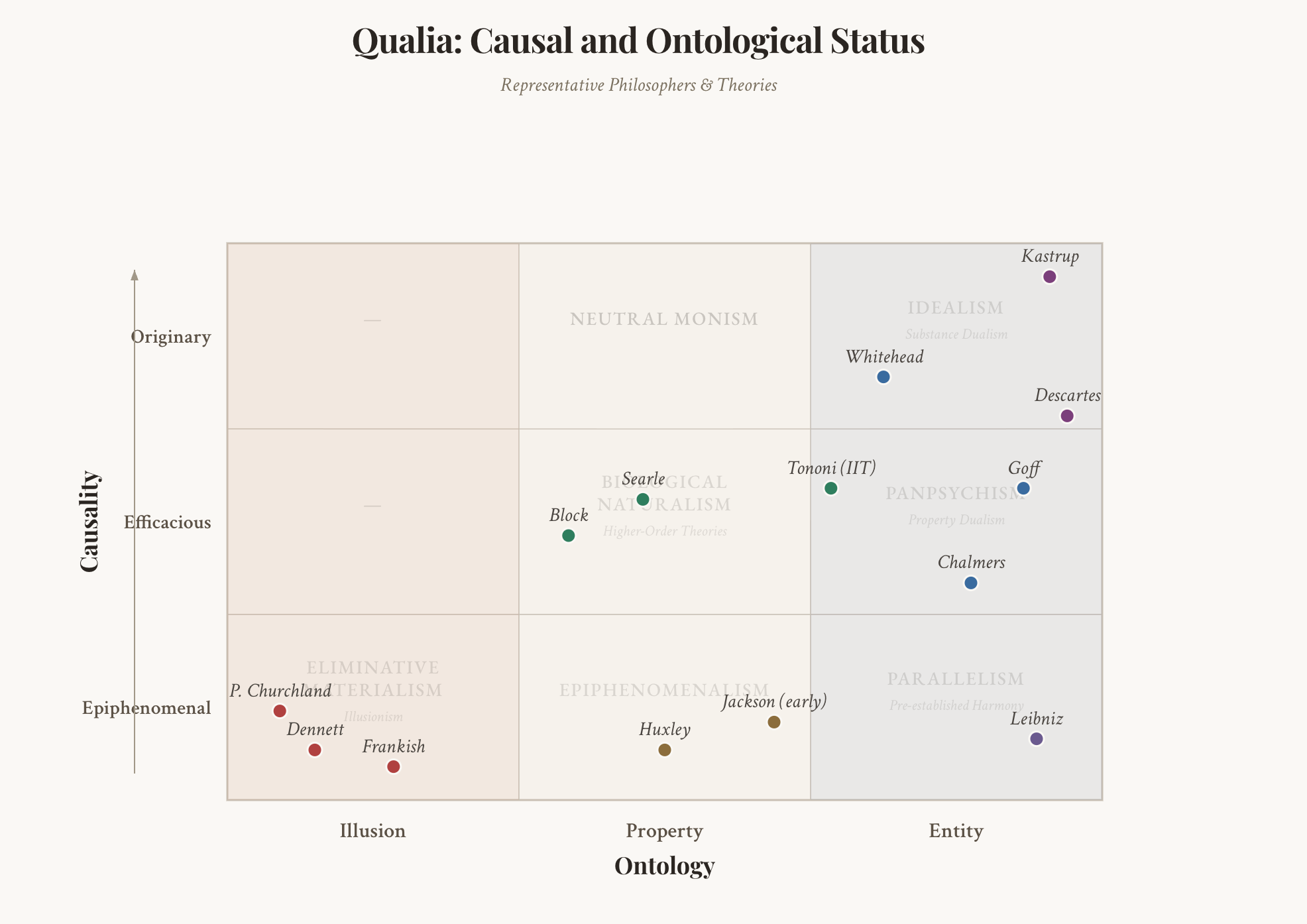
I also gave Claude an empty copy of my matrix, with a redacted excerpt from this section, to see where it would place representative philosophers (treating axes as a spectrum) and what 1-2 representative theories it would place in each box. I ran this about 5-7 times with different degrees of redaction (including no excerpt at all) and got a few different results. Several philosophers were extremely stable across runs (Dennett, Churchland, Searle). Chalmers was exceptionally unstable, shifting between 5 of the 6 boxes in the property/entity columns. In the output closest to my own reading, Claude labeled Chalmers’ box as “Panpsychism,” which is a sick burn.
A Problem of Terms
In an earlier draft of this post, I attempted a reductive definition of qualia that simply asserted them as “the entities of the mind that others cannot observe or infer.” I still fall back to this definition when struggling to articulate what exactly subjective experience is, aside from known neurophysiological processes. Regardless of whether you assign qualia any special ontological status, I find it hard not to still recognize the mystery of phenomenal consciousness (unless you insist that phenomenological experience is an illusion).
So, in the spirit of that former reductive approach, let’s proceed through a few of the relevant terms in the causal chain leading from external entities, through neurophysiology, ultimately leading to consciousness and qualia. I’ll provide a concise definition for each, and make a few clarifications or claims to advance our discussion.
Entity
I will use the term “entity” to refer to anything that exists. I will use the qualified term “natural entity” to refer to any entity with a corresponding natural substance, typically understood as physical reality. I will use the term “metaphysical entity” to refer to any non-natural entity. I will use the term “mental entity” when dealing with dualist claims as to non-natural, but also non-metaphysical entities.
For discursive purposes, I will also distinguish entities from properties. I will use “property” to refer to an attribute characterizing an entity (the way an entity is), which property has no natural existence without a dependent entity. An example might be the temperature of water or the mass of a particle.
In my second post, I will explore the implications of these different ontological readings more thoroughly. For now, we should simply allow that such claims exist, and that claiming qualia as a property of neurophysiology or a distinct substance caused by neurophysiology is to claim qualia as natural or mental properties or entities.
While a direct refutation of dualism is outside the scope of my first post, I will still mostly exclude mention of mental properties/entities from my discussion below. For now, I will prioritize positive arguments for a natural interpretation of qualia, rather than negative arguments against a dualist or mental explanation. If you stick to a dualist point of view, then I suspect most of my discussion still holds if you just substitute “natural” with “mental.”
Stimulus
I am going to hazard what might be a heterodox definition for stimuli.
I will use the term “stimulus” to refer to any natural entity one would place in the direct chain of causation leading to a change in consciousness. That includes external stimuli, like the light shining from a bright blue sky, or the rustle of leaves. But it also includes our eyes and our brain.
Many stimuli are external. Our sensory organs transduce external stimuli into the neural activity begetting conscious experiences such as vision. So it is with sight, hearing, touch, taste, etc. The five classic senses have a clean internal/external differentiation. But what about emotions? Memory? I may have a feeling of joy staring at a bright blue sky, which has a close causal relationship with the sky. But I can also feel pleasure at the end of a long chain of cognition, or after a nice dream. I may feel joy or sadness at the end of somatic processes outside my control. I may hallucinate from sleep deprivation or a mental illness. How do we understand the stimuli leading to our individual thoughts? Are they not, in many respects, the operation of neurophysiology itself? If my consciousness changes as I mentally compose my argument, how would you locate an external stimulus for that change?
Our brain constantly intakes external stimuli, and we may, after much searching, find an external provocation for many of our thoughts and feelings. But we would be hard-pressed to find a direct, external corollary for every change in consciousness. From the perspective of consciousness, why differentiate between an internal and external stimulus? It is all just happenings in the natural world that may or may not lead to a change in consciousness.
Neurophysiology
I will use the term “neurophysiology” to refer to the broad set of somatic processes that are directly responsible for consciousness, i.e. that enable consciousness in animals.
My assumption is that neurophysiology is a direct and sufficient cause for the appearance of human consciousness. I am not aware of any scientific evidence for another physical cause. I refer to “neurophysiology” rather than the brain, so we do not need to debate the relative role of the sympathetic vs parasympathetic nervous system, etc.
I will not make any claims as to why neurophysiology causes the appearance of conscious experience (qualia). Nor will I make a strong claim as to whether neurophysiology is the only possible cause of consciousness. Given conscious experience includes senses like sight that do not require high-order thinking, I assume other animals have conscious experience too. Though it’s unclear how far down the chain that goes—at least through the vertebrates? Probably further?
My best guess is that there is something about the exact nature of neurophysiology which causes consciousness, meaning a non-biological artificial intelligence is unlikely to experience it. However, this is only philosophical speculation! The core thesis behind this series is that we ought to treat the “hard problem of consciousness” as a scientific problem. We simply do not know whether an AI does or could have consciousness. Nevertheless, I am very skeptical of strong functionalist claims to consciousness, as in the Chinese nation problem (which is a thought experiment, not a national security policy).
As asserted in the previous definition, some subset of neurophysiological processes are also stimuli, or can be stimuli. Introspection seems to allow a surprisingly large number of processes to become stimuli for consciousness (consider a meditation on breath). Homeostasis would be a good example of a process that is not a stimulus for consciousness, though we notice the consequences when it fails.
NB: I would like to take this moment to remind you I am neither a doctor, nor a psychologist, nor a scientist, nor a philosopher, but just Some Dude. If you think my definitions are inaccurate, or stupid, please let me know, and I will adjust.2
Consciousness
I will use the term “consciousness” to refer to the entire set of qualia available to an individual at any given point in time, fundamentally constrained by an individual’s underlying neurophysiology. This is often referred to as phenomenal consciousness. But isn’t non-phenomenal consciousness a contradiction? Especially if I denote cognition and feeling as activities of neurophysiology, not consciousness.
My definitions ask neurophysiology and qualia to do most of the heavy lifting of consciousness. If we posit that neurophysiology is solely responsible for the appearance of consciousness, and that the experience of consciousness is simply the set of all present qualia, then what is left to consciousness itself? All the old machinery of consciousness has shifted elsewhere.
This is what I mean when I assert that muddled terminology has led to misguided discussions around consciousness. Consciousness, as a concept, is still burdened with unscientific readings of mental processes that precede modern neuroscience. It seems to me that the vast majority of the mind can be understood mechanistically through neurophysiology, whether that be cognition, feeling, memory, etc. Phenomenology is the hold-out.
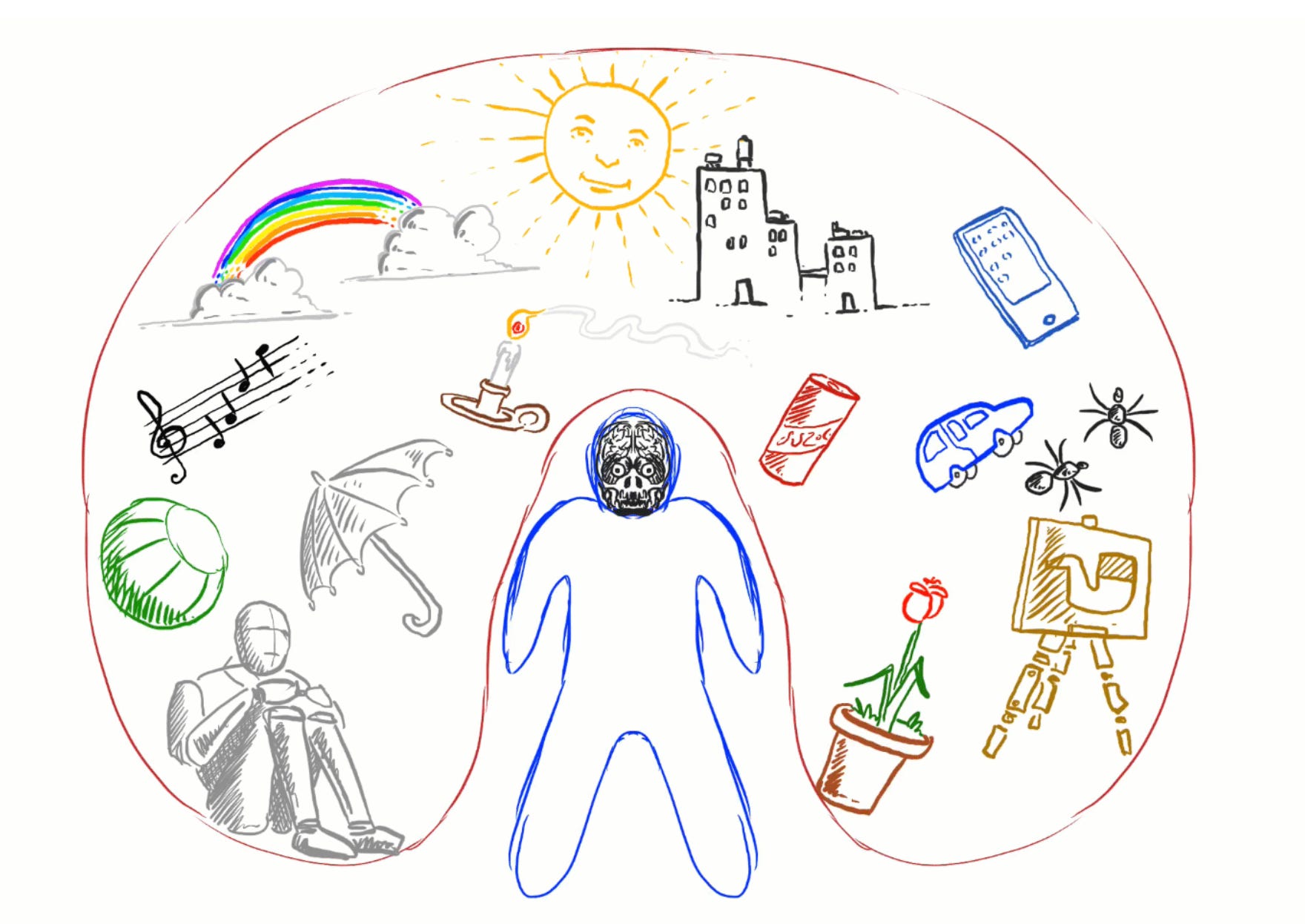
That being said, an open question in my own thinking on this topic is whether consciousness offers any unique role in introspection and awareness, or in the apperceptive self3. Though I take a highly mechanistic view of cognition, I still have the impression that I am a single self, and that my self actively experiences qualia. Perhaps the simplest explanation would be to say that my impression is false; actually, there is no self apart from my experience of consciousness. My “self” is simply the qualia I experience in a given moment, alongside the machinations of my body.4
Ricardo Manzotti provides a related set of conclusions with his concept of the “spread mind,” which conflates the self with our experience of the world.
However, I do not think we can make any strong claims as to the apperceptive self, until we have answers for the hard problem of consciousness, i.e. why consciousness arises at all. I have so far defined my terms under the assumption that the process from neurophysiology to consciousness, particularly conscious experience, is unidirectional. But can the causal chain operate in the other direction, from qualia to neurophysiology?
This does not necessarily mean that consciousness “controls” neurophysiology (very unlikely), but that consciousness can sit somewhere in the causal chain, even if that just means that neurophysiology can “perceive” qualia. Minimally defined, this could be a process like: no qualia → “neuron of conscious experience” set to 0 → qualia experienced → “neuron of conscious experience” set to 1.
Taking a physicalist, scientific perspective, a naive first reading of this problem might say it is obvious that qualia cannot effect neurological change. But this leads to a few strange conclusions. The first of these is that we must then take an epiphenomenal view of consciousness. Consciousness is then merely a by-product of neurophysiological activity, like the steam boiled off our electric kettle.
To make an epiphenomenal view consistent with a causal understanding of neurophysiology, we must then either accept conscious experience as an illusion (weird), or, that our self is exclusively our conscious experience (we are qualia; also weird). If qualia cannot interact with neurophysiological processes, then there is no “bridge” to connect our mind and body. Perception and self-awareness are only neurological processes working against themselves. Our neurophysiology cannot perceive qualia, it just processes stimuli.
Stated as a set of logical propositions (proof by contradiction):
I assert that cognition is fully explained by neurophysiology
I claim to perceive qualia
However, I also claim that qualia cannot cause any change in my neurophysiology
If qualia cannot cause any change in neurophysiology, and cognition is just neurophysiological processes, then qualia cannot provoke any cognition
Hence, I do not perceive qualia
Chalmers refers to this as the “Paradox of Phenomenal Judgment.”5 I am unsure whether novel science could circumvent such a proof. Suppose that consciousness interacts with neurophysiology only via forces that have no causal impact. Maybe a weak gravitational force? Or a novel physical force? This is also very strange, and I’m unsure how it fits with quantum field theory. The very weirdest version of this would be something like monads (ontological entity, epiphenomenal), where consciousness is some unknown natural or mental substance existing in parallel to our neurophysiology. I suppose someone could make a clever argument for qualia as epiphenomenal properties that could reduce the amount of novel science required for a natural explanation?
Introducing a causal nature to qualia also has weird consequences for science (what could be the natural entity intervening in neural activity?), but allows for more “common sense” readings of conscious experience. If we allow a causative role for qualia, then we no longer have to tie ourselves in knots justifying subjective experience. This is intuitive, and though intuition is not an indicator of what is real, I take it as a useful starting point for an investigation of the unknown.
To this end, for any scientific readers in my audience who are tired of philosophy and think this is all a load of kvatsh, I would like to offer the causally efficacious, ontological property reading of qualia.6 Rather than having to posit unique physical substances, this would allow us to discuss qualia as not yet understood properties of neurophysiological activity—as constitutive of neurophysiology as, say, the wave form of a particle. You would also eliminate the problem of epiphenomenalism by identifying qualia as inherent to the causal process itself. This would move us closer to the “steam engine” model of the mind, where consciousness (“steam”) is constituent to the overall mechanism, not incidental.
It would in many respects be simpler if solving the hard problem of consciousness meant discovering new physical properties of neurophysiology or neurophysiological activity, rather than having to discover an entire new class of natural entities (a substance), or having to explain unidirectional causality from neurophysiology to conscious entities. But the validity of each is still unknown.
NB: I am not very familiar with Integrated information theory or Global workspace theory, which by my understanding are two of the leading scientific theories of consciousness? At a first reading, neither seems to do a very good job of providing a physical/naturalist explanation for qualia (though IIT does better?). To the best of my knowledge, both are still largely theoretical, without any decisive empirical backing. They are also not without their detractors. I am just very skeptical that any full explanation could be found without novel physics. As an example, Dwarkesh Patel recently linked to this talk by Max Hodak. Whether or not the specifics are correct, this seems to me like a better approach. I’ll speak more to these ideas in the second post.
Qualia
I will use the term “qualia” to refer to subjective experience itself, which is the uniquely apprehended property/entity that is both ineffable and private.7 Qualia are distinct from cognition and other processes which evaluate our experience.
Qualia, by this definition, share similarities with noumena, quiddities, dasein, and other terms pointing to entities that are fundamentally unknowable or inaccessible. The miraculous difference with qualia is that they are apprehended! Perhaps too well? A philosopher is more likely to have to fend off sophomoric claims of idealism8 than to have to argue whether we apprehend qualia.
We can communicate about the subjects of conscious experience, but the experience itself is untransferable. We have no access to conscious experience from outside an individual subject. The subject has no ability to transfer their experience to us (I cannot share my experience of the color blue). Yet we still have knowledge of this experience within the privacy of our mind.
I do make an important distinction between qualia and our evaluation of experience.
Suppose, for example, I take a sip of a delicious cup of coffee (like Dennett’s Chase and Sanborn). I have a clear subjective experience of coffee, maybe even of a specific roast, and a clear subjective assessment of the coffee as good. Does that mean there is a quale of coffee? Or a quale of good-coffee? Or a quale of good-brazilian-roast-coffee? This seems very strange! It would be hard to square a naturalist/physicalist interpretation of reality with such specific kinds of qualia.
However, I would not assert any a priori need to distinguish kinds of qualia. Perhaps there is only a single kind of quale, and discernment is only a function of neurophysiology. When sipping our coffee, our experience is of the neurophysiological activity associated with tasting coffee, and the related neurophysiology for a provoked feeling of pleasure. For both, there is only a single kind of experience. All knowledge and judgment of those experiences exists within the brain.
I am thus open to a reading of qualia as illusion in this narrow framing, where we accept qualia themselves as legitimate, but not any meaningful differentiation between qualia. Personally, I find the weirdest consequences of this treatment to be color. If we claim qualia are undifferentiated, then we must also assert that there is no fundamental differentiation between our experience of blue and red, green and blue, etc., only our evaluative judgment separating the two. This seems almost as odd as a quale of Brazilian coffee (QoBC?).
The two arguments above explain why I have come to lean towards a view of qualia as properties of neurophysiology, rather than distinct entities. If the experience of “red” is an unknown set of natural properties for a neurophysiological perception of light, well, then in some sense the perception is the color. We don’t have to make counter-intuitive claims about our own experience. The experience itself is differentiated, because it is strongly correlated with differentiated neurophysiological processes.
While a property view does not ipso facto restrict consciousness to neurophysiology, it does present a burden to prove consciousness in entities of a different natural structure. Artificial intelligence is the best example of this. If you query an AI on its consciousness, or read the reports of others having done so, you will not ascertain whether it has phenomenological experience. I am sure we can build AIs that match and exceed all our cognitive capabilities. But without the right physical substrate, it is unclear why qualia would arise? Asserting a strong functionalist claim for the consciousness of artificial intelligence is thus highly problematic. I’m unsure how you could stick to an understanding of consciousness as a property, or even as efficacious, while assuming AI has consciousness. I would ask representatives of this view to assess whether they have not accidentally proposed a monadological theory of consciousness.
Thought Experiments
I have a small grudge against thought experiments / intuition pumps, because they are sometimes abused to make arguments about definitions rather than arguments about truth; or to make metaphysical arguments when we want to make physical/natural arguments. However, it would be remiss to write a post about qualia without engaging with the many thought experiments written in this domain. I will evaluate several according to my definitions and personal views, and leave it to the reader to decide whether I am better or worse off for the outcomes. Rather than introduce each experiment, I will link to a relevant source for anyone unfamiliar with the terrain.
Humans have three types of cone cells, which leads to our trichromatic perception of color. Some animals have more (goldfish are tetrachromats; pigeons are pentachromats), meaning richer understanding of color, and very likely perception of fundamentally new colors that we cannot comprehend with our physiology. This is a good example of what we mean when we say that neurophysiology set the bounds on consciousness. What would it mean to have a fourth cone that perceives the “color” of ultraviolet light, as a goldfish might? What if ultraviolet light was so important to a species that it evolved two additional cones dedicated just to that electromagnetic spectrum? Is that possible? Is there a hard limit on the divisibility of light into more colors?
I bring this up simply to say that we already have strong physical evidence that other animals can perceive more fundamental colors than us, meaning we already know there are qualia of color we do not experience, and that we cannot comprehend. If there are other fundamental colors, then who is to say that our colors might not already be swapped, or already be fundamentally different, person to person? We know there are more. What if there is an infinite number of fundamental colors that vary, person to person?
So, I find no contradiction in the general argument of the inverted spectrum hypothesis, namely that it is conceivable that qualia differ between persons. I do, however, find it very unlikely. It seems much more likely to me that the specifics of our visual neurophysiology leads to the specific qualia we experience, and that without a different physical substrate the qualia themselves will not differ. It’s also unclear to me if one could actually neatly invert red and green with no changes to our perception of light and color?
Conclusion: Qualia, as represented by color, may not be equivalent across consciousnesses. But it’s unlikely to be such, following a property understanding of qualia.
My ungenerous interpretation of Mary’s room is that it is a nearly useless thought experiment.9 It does demonstrate that we have subjective experiences distinct from our knowledge of the underlying stimuli. However, it does nothing to advance an anti-physicalist argument, aside from demonstrating that anti-physicalist arguments typically fail to anticipate novel physics.
To quote Thomas Nagel, in his famous “What Is It Like to Be a Bat?”:
At the present time the status of physicalism is similar to that which the hypothesis that matter is energy would have had if uttered by a pre-Socratic philosopher. We do not have the beginnings of a conception of how it might be true.
Leaving the room and perceiving color for the first time, Mary’s neurophysiology enters novel physical states which either have a unique natural property, or cause a unique natural entity, corresponding to a quale. This does not refute physicalism, but merely points toward a significant unknown in current physical models.
Conclusion: Subjective experience is distinct from knowledge of physical facts. Qualia may still be physical.
By our definitions, the conceivability of zombies hinges on the causal problem of consciousness. If phenomenological consciousness does somehow have a causal effect on neurophysiology (i.e., if there is just one binary neuron that “flips” based on the presence/absence of qualia), then a perfect zombie is not possible. Otherwise a philosophical zombie should be conceivable, by our mechanistic reading of neurophysiology. If phenomenal consciousness plays no causal role in neurophysiology, then zombies are conceivable (even if they may be still be impossible, i.e. something inherent in neurophysiology causes consciousness).
Chalmers comes to the same conclusion on the logical possibility of zombies, which is one in a few steps he takes toward a “naturalistic dualist” interpretation of consciousness.10 However, while I agree that conceivability may point toward metaphysical possibilities, it does not actually determine natural reality—as Chalmers himself states, “logical possibility and natural possibility are different things.”11 Though it is metaphysically possible for my hair to turn green tomorrow, it does not mean it actually will. As I have stated repeatedly, we simply do not know the actual causes of consciousness, or the nature of qualia, so it is impossible to make any definitive claim on whether a zombie really could exist.
Conclusion: Zombies are conceivable. But it seems very unlikely a human zombie is actually possible.
The “what it’s like” to be a bat is to have the qualia available to a bat, with a bat’s limitations to consciousness. Presumably bats, like people, also have an apperceptive self.
We haven’t taken a hard stance on whether qualia fundamentally differ between stimuli—whether there is material difference between qualia of sight and qualia of sound, or if this is merely an evaluative function of neurophysiology. Regardless, we would expect bats to have qualia of “sonar” differing from our qualia of sight, due to a capacity to process a type of external stimuli differently from our neurophysiology (different sensory organs and different neurophysiology). What is unclear is whether the experience of sonar corresponds to a novel property/entity (a unique “quale” of sonar), or simply an evaluative capacity of a bat’s brain.
Following my mechanistic understanding of cognition, I am less fussed by what it would mean to “think” like a bat. To think like a bat is merely to experience a bat’s cognition. Whatever neural activity provokes consciousness in a bat would cause a correlating, bat-like experience.
Conclusion: There is a what it’s like to be a bat, though we don’t know if the experience of being a bat corresponds to any novel qualia (the parameters of consciousness change, but maybe not the properties/entities).
I have the impression that the Chinese Room plays an outsized role in discourses around artificial intelligence. It’s a good thought experiment! Searle insists on the necessity of a biological foundation of consciousness more strongly than I do, but I would still agree it is very likely.
Whatever else intentionality is, it is a biological phenomenon, and it is as likely to be as causally dependent on the specific biochemistry of its origins as lactation, photosynthesis, or any other biological phenomena. No one would suppose that we could produce milk and sugar by running a computer simulation of the formal sequences in lactation and photosynthesis, but where the mind is concerned many people are willing to believe in such a miracle because of a deep and abiding dualism: the mind they suppose is a matter of formal processes and is independent of quite specific material causes in the way that milk and sugar are not.
— John R. Searle, “Minds, brains, and programs” (1980). Emphasis my own.
My main objection to Searle’s argument would be his use of the term “intentionality.” It’s a good example of why we ought to stick to qualia when seeking to differentiate consciousness from the mechanics of thought, whether that be in neurophysiology or neural networks. Where does one locate intention in the human mind?
As I have already mentioned, I do not yet have a clear opinion on where we should locate the apperceptive self. I am unclear whether concepts like perception and self-awareness and intentionality are intrinsic to consciousness, or merely post-hoc justifications for neurophysiological processes, which sit alongside the experience of qualia. Using terms like “intentionality” brings on claims I do not wish to make. I only want to assert that qualia are distinct entities, which we and other animals possess, and very likely artificial intelligence (as it exists today) does not. I don’t want to trip up that claim by arguing what counts as intentionality in biological or artificial “brains.”
Conclusion: Agree that our best guess ought to be that AI does not have qualia. Quibble with the use of the term “intentionality,” which AI could possess, depending on the definition.
Why are there multiple thought experiments set in China? Probably this is some form of mid-century Orientalism? What of the consciousness of the French Nation, among others?
Regardless, it seems to me that only a panpsychist or hard functionalist interpretation of qualia would support consciousness in this experiment. If one supposes qualia are actually ubiquitous physical properties of nature (an extreme version of our efficacious-property view), then I suppose you could still assert qualia would arise, but I don’t see a basis for arguing a unified consciousness / apperceptive self. I won’t make the effort to steelman this final experiment, but I’m happy to hear better arguments for it.
Conclusion: No consciousness, unless you take a hard functionalism or panpsychist approach.
Experience the Qualia of My Conclusion
I lightly workshopped this post before sharing externally, but the opinions here mostly reflect my own thinking and exploration of the subject. I will admit that I began this essay with a strong belief in an entity-oriented understanding of consciousness. But I found myself backed into a corner once I recognized the causal difficulties of that view, and then switched to the efficacious-property hypothesis as the most likely explanation. I’ve only assigned a 45% likelihood on my personal “scorecard” above, but this reflects a more fundamental uncertainty about the problem than a doubt to my reasoning.
Ultimately, what qualia might be is a question for science. Maybe there are “particles” of consciousness—who knows! My purpose has only been to explore the likely philosophical explanations for qualia, and in doing so to assert that they are real, and worthy of targeted investigation.
When I read discussions of consciousness online (particularly in our post-AI age), I see far too much emphasis placed on questions that I believe ought to be understood mechanically, metaphysically, or some mixture of the two (i.e. intentionality, knowledge, agency), but that have no bearing on consciousness per se. Because without phenomenal experience, there is no consciousness! Without qualia, we are just making metaphysical arguments about the behavior of intelligent beings (except for apprehension?12).
In my second post, I’ll continue this discussion of qualia, but shift attention to the ontological and causal definitions we’ve allowed ourselves to use loosely until now. In particular, I expect to defend the preservation of metaphysics as a concept, while rejecting non-naturalist or non-physical explanations for qualia and other unknowns. I’ll also explore further the implications of the private nature of qualia, specifically what it implies for science if we know there is at least one apprehended property/entity that we cannot otherwise observe.
If you have any objections to the above, please let me know, and I will publish an addendum alongside my second post in the series.
To extend the metaphor, a spiritualist interpretation might say consciousness is the water turning a mill.
In the near future I’d like to write about this problem of extending oneself outside one’s formal area of training to comment on other disciplines. I know some writers address this by formally stating the “epistemic status” of their inquiry.
I treat the unitary self as distinct from the apperceptive self. Our apperceptive self experiences memory and other neurophysiological processes that merely give an impression of continuity. Galen Strawson’s “Things That Bother Me” has a few good arguments in this direction.
It’s a little outside the scope of my essay, but I would also like to advocate for a holistic interpretation of the self, including both the mind and body. Questions like free will become less problematic if you stop identifying yourself with a fictitious homunculus sitting in the back of your head, and rather identify yourself as your entire person (mind and body).
I first thought of this proof myself while preparing this essay, and was frustrated to learn I was 30 years too late to claim any originality. If only I had been a more precocious child.
“CEOP-ToQ.”
In his hit piece “Quining Qualia,” Dennett further defines qualia as non-relational (“intrinsic”). I’ve excluded it, as I am not convinced it is essential to our definition. “Ineffable,” “private” and “apprehended” already seem sufficient to me to differentiate qualia from other entities. I haven’t thought deeply about this yet.
I am not refuting the trouble of solipsism.
I have the subjective experience of impatience the closer I get to my conclusion.
Chalmers, David J.. The Conscious Mind: In Search of a Fundamental Theory (Philosophy of Mind) (p. 94). (Function). Kindle Edition.
Chalmers, David J.. The Conscious Mind: In Search of a Fundamental Theory (Philosophy of Mind) (p. 257). (Function). Kindle Edition.
Alright, I will admit that I do still have an open question about apprehension/selfhood, as mentioned in the section defining consciousness. However it’s unclear to me what it would mean to be a “self” without qualia. There is maybe an argument here about imagining a self without memory? Or rigorously defining the status of the self when we sleep, when we’re unconscious, etc.