
Friendship
Fiction #1

Waking up at 5 in the morning, Francis rubbed his chin hair and asked his pet tarantula what he would like to do today. Bobby, the tarantula, was 8 inches wide, from foot to foot. He sprang onto Francis’s hand in response to the question. Francis carried Bobby around the house while he drank his coffee. Bobby could not speak to Francis directly, but Francis intuited answers that became clearer with time.
Francis loved to take Bobby outside, because outside Bobby was free. Francis surmised that he himself was never free, as he was slave to a system outside his control. Though he sometimes attributed this system to his employer, he felt his non-freedom was actually a property of the system itself, which he referred to semi-ironically as “The Man” (he scare-quoted the term even in his mind), and that he had little chance of escaping. While several of Francis’s friends had moved on to accomplish great things, Francis had always stayed put. Francis had considered this an act of rebellion, perhaps the only kind possible to a man in his situation.
Bobby did not think at all about systems or freedom. Bobby, as an arachnid, was only capable of brief cognitive tasks. Bobby experienced small joys, like the rush of walking on bodies, but he had no capacity to ruminate on joy. Bobby had a subjective experience of life that extended just beyond his carapace, and only a dim awareness of his keeper.
It proved to be a sunny day, so Francis wanted to go to a park. This was a day off for Francis, and he was done with sitting on his phone watching videos, he was really going to do something and take Bobby outside. Francis had vague ideas that the sun powered the world, so it was important to sit in the sun and accept its energy. Bobby would also lie on his chest, or settle into his portable terrarium, as the two heated then annealed through the afternoon.
When outside with Bobby, Francis spent a non-trivial amount of his time worrying whether Bobby would die. There were many heavy objects outside, which rarely fell without warning, but it had happened, and an object would not need to be so heavy to hurt Bobby. There were also dogs, which were purpose-built to kill or maim the helpless. Francis had briefly considered a dog before getting Bobby, but as he was careless and sometimes did not leave his home for days at a time, he decided a dog would be a poor fit. He was very happy he had Bobby and would not be happier if he had a dog.
Today was a Thursday, which was sometimes a day off, depending on the schedule The Man gave him, and the park was full of families, which Francis found strange, because children and parents had responsibilities he did not. Bobby saw the children in only the strange spider-like way in which Bobby perceived anything, which is a complete mystery to both Bobby and myself, because I am not a spider nor an arachnologist and so can only rely on what Francis and Bobby have told me, which is little.
But Bobby, if I were to extrapolate, is a very happy spider. Bobby is covered in hairs that quiver when Francis picks him up. Bobby exists for a few basic purposes in life, one of which is to reproduce, and the other of which is to kill. Bobby loves to eat the roaches and grasshoppers tossed into his terrarium, though again “love” is a hard concept to attribute to Bobby. Bobby has strong desires that cause him to behave in certain ways, and Bobby has an experience of these actions but rarely reflects on them. Still, there is something, isn’t there, that makes Bobby act the way he does? And isn’t that something the special connection between Francis and Bobby? Which Francis is in this moment so sure of, as he lifts Bobby onto his palm, raising him toward the tulip tree, under which he’s laid his beach towel.
Francis is sure he was meant to become someone more than the person he is, but he’s unsure who that someone would have been. Francis was not happy in school, nor is he at work. He was happy at home, though he was also depressed at home, and he is happy at the park or walking in the woods, but only briefly, and then he is desperate to return home. Francis felt confused about the person he was supposed to be, but he had never been told who that should be, and he could not figure it out on his own.
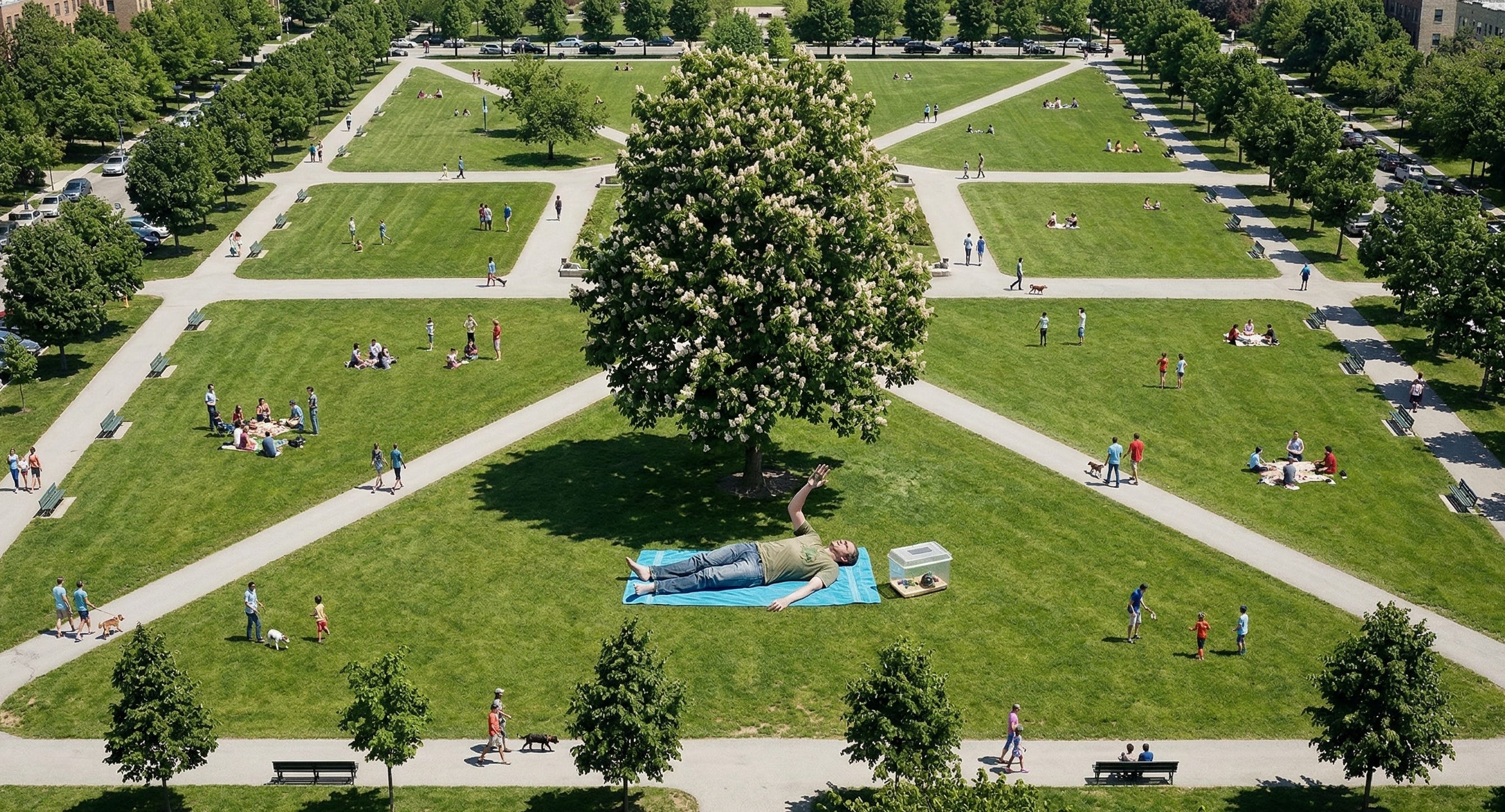
If it were possible, I would give Francis a sign. I would, I really would! But Francis is locked into a journey of his own imagination, refusing to admit the little faults that have put him in this position. And while it is true that life has never been fair to Francis, it has also been true he has never put in too much effort, despite the structural advantages that might have allowed him to do much more than he ever did.
Francis is now lying down, trying to convert the warmth of the sun into the will to become the person he was always supposed to be. Bobby, meanwhile, crouches in his terrarium, nearly unconscious, dizzy with extraterrestrial energy.
Francis weaves in and out of sleep as he is obliterated by UV rays, unshaded by the tulip tree in the late afternoon. Francis dreams about his mother, briefly, before imagining his whole body as a gelatin mold. It is a moment in which every consideration feels profound. He, in his half-consciousness, tries to direct his imagination towards more epic thoughts, such as what it would be like to be a tarantula, or a sex icon. But Francis’s inner self bucks at the suggestion, kicking him out of his own unconsciousness, until he gives in, allowing his deepest anxieties to once again direct the frame of motion. Francis, when fully asleep, has his recurring stress dream that he is lost in an auditorium full of toilets.
Tarantulas have 8 eyes and 2 kinds of photoreceptors, which allows Bobby to perceive Francis from a multitude of angles and in colors which are totally inaccessible to humans. Francis has never thought of this, not exactly, but it would only further endear Bobby to him if he had. Bobby sits and does not look at anything, or not with focus. Bobby, as an individual self, barely exists as he sits in his blazing hot plastic cage, nestled in the grass beneath a tulip tree on a late afternoon in May.
Bobby is fine once he is back home in the cool apartment where he and Francis live. Francis is red in the face from having slept in the sun, but Francis has always considered himself swarthy, since his father was Mexican, even if he otherwise looks entirely Caucasian and cannot speak Spanish and has no cultural connection to Mexico, since his father moved to America at a young age and did not talk about his past, or even have a very close connection to his own parents. Francis in this way feels as though he has been disinherited from a culture he had a right to, yet which remains inaccessible, except through cliché tokens of culture, like a tortilla press, which he never uses but leaves on display.
Francis, however, does not like to think about culture and race, because it only makes him angry, as the world is already full of people who do not understand him, and this is one of the many dimensions by which he is not understood. He does, in this respect, among others, greatly envy Bobby, who has never been interpellated, except somehow as a pet, or an enemy.
While Bobby sits alone in his dimly lit terrarium, he has a growing awareness of his surroundings, because at some low level he is aware he must eat. This is not urgent, because Bobby has recently eaten, but he is still aware that he must. This is a dumb, mortal impulse in Bobby, one of the few things that carries him forward. A sensation of what must occur, else everything will end. Bobby’s own struggles are best encapsulated in this tension between the need to eat and his indifference to eating, up until the moment where eating becomes an absolute imperative, which has only occurred rarely, like during one of Francis’s depressive episodes, when even Bobby is beyond his interest.
Francis did not talk to Bobby again that day or even look at him. When he goes to bed, Bobby will have crawled up one of the glass walls of his terrarium, but Francis will accept this as a smear in the phantasmagoria of conscious experience, along with all the other stimuli leading to the perception of his room.
Francis was tired of living every day so mechanically, but he could not find a way out. He ate his dinner on the couch and then spent a very long time looking at his phone. Francis later lay in his bed and wondered why he must be mortal.