

I’ve always liked learning about the mechanics of how others write. Common advice like writing every day or not pausing to edit is fine, but what I really want to know is what’s going on inside your head, what are your fingers doing, and what does your draft even look like.
For example, I have spent a lot of time writing on my phone. This works really well for poetry, but it’s terrible for essays. When writing longform non-fiction I like to open up my laptop and write my drafts in Microsoft Word. I worked with Google Docs for a long time, since it’s free and online, but I find it much worse for working through subsequent drafts of an essay.
I’d like to distinguish between editing a draft and revising one. Editing is a lot like trimming a hedge. The content you want after editing is mostly in the document already. You might swap out words to improve style or clarity or completely rephrase a few sentences. You will, occasionally, add a new paragraph, because you insufficiently explained a point, or find there’s a tangent you want to explore. But you don’t make deep structural changes to an essay when editing. When trimming a bush, you might cut the branches, but you rarely pull up the hedges by the roots and rearrange them.
A full revision, or restructuring, is much more radical than editing. When I see advice to just “write” and edit later, I think to myself that this is a writer who doesn’t create many revisions! They are probably very good at determining the structure of their argument up front, so that even if their first draft were written with the vocabulary of a four-year-old, they could still edit it into a sensible essay. But revision is much more difficult mechanically than editing, because it is more spatially complex.
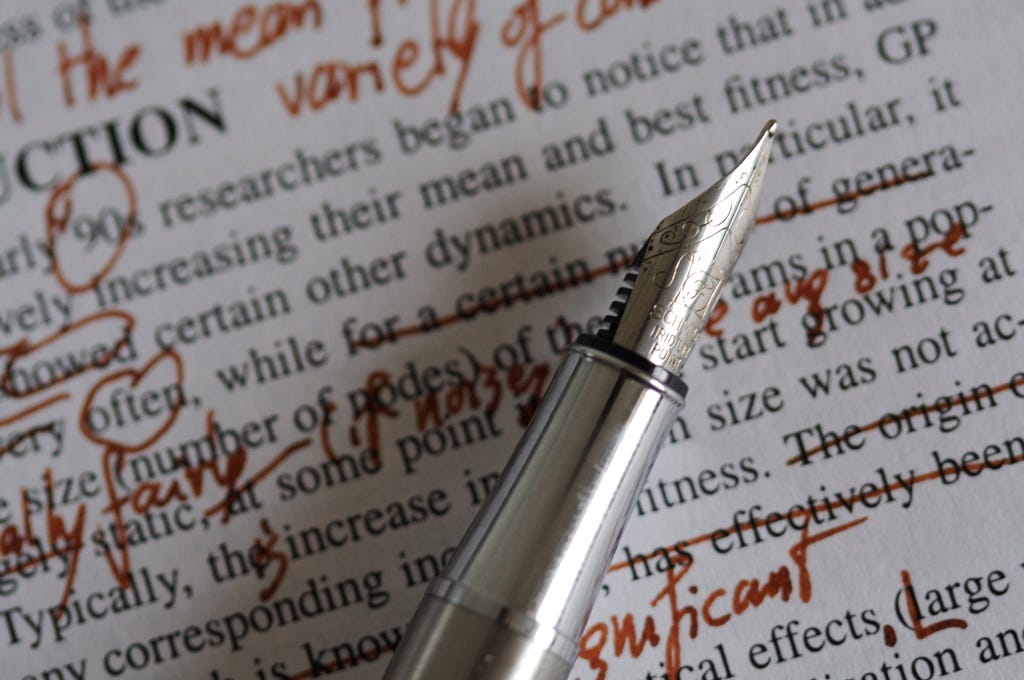
Word’s track changes mode is very useful for editing, though I unfortunately went most of my adult life without realizing it was available, and only learned about it once I had to review redlines in legal contracts. Redlining makes your edits legible in situ, exactly where you want them to occur. It’s visually and cognitively simple to understand.
There is no equivalent to track changes for revisions. Have you ever tried deleting entire paragraphs, then splitting them into new sections elsewhere in your document? Your whole screen will turn red and the sidebar will be overwhelmed with useless marginalia.
When I begin a new revision, I typically just create a new Word document. It’s a lot easier than trying to track a huge set of changes in the version history. I can imagine the new and old arguments floating around as sections in my head, but physical corollaries for an entire draft are unwieldy. I’ve tried printing out my drafts, but I find this becomes a mess of crosses and arrows. I’ve also seen some text editors with features to help manage revisions, but the implementation feels clunky to me, and potentially a distraction from the writing process itself.
So, I haven’t actually found a mechanical solution for revision that is better for me than holding the abstract arguments in my head, recomposing them and writing it all down again. I do still cannibalize text from previous drafts if feasible.
My sense is that revision, as I use it here, is structurally difficult to execute for any project. If you accidentally wrote your entire e-commerce platform as a WordPress plugin, then good luck revising it to use a microservices pattern. If you architected a building for the calm of northern Europe, then good luck revising it for a development in southern Florida. Structural redesigns are really hard, even if your essay/software/building serves the same purpose as you’d originally intended.
If revision is mechanically very hard, then we should try to ensure our revisions are infrequent and lower cost. If you are not confident going into your first draft, then have an idea of the word count you’d be willing to repeat for a ground-up second draft. Or be a better planner. Create a bullet-point list for the argument or do storyboarding. Imagine you are a paranoid producer of a big-budget film, terrified of having to redo any expensive shots.
The advice to write without stopping to edit yourself is very good, but just remember that editing is easy, while revision is hard. The better the structure of your first draft, the less time you’ll spend writing overall, even if you still need a lot of edits.
_-_31.jpg)